
June 10, 2026
Best Bolt.new Alternative for Full-Stack AI Apps
what is the best bolt.new alternative for serious full-stack development? That is where Minuano.ai enters the conversation. Minuano.ai is being built for users who want the speed of an AI web app builder without feeling trapped by token-burning workflows, fragile iterations, backend lock-in, or codebases that become harder to maintain every time the project grows.
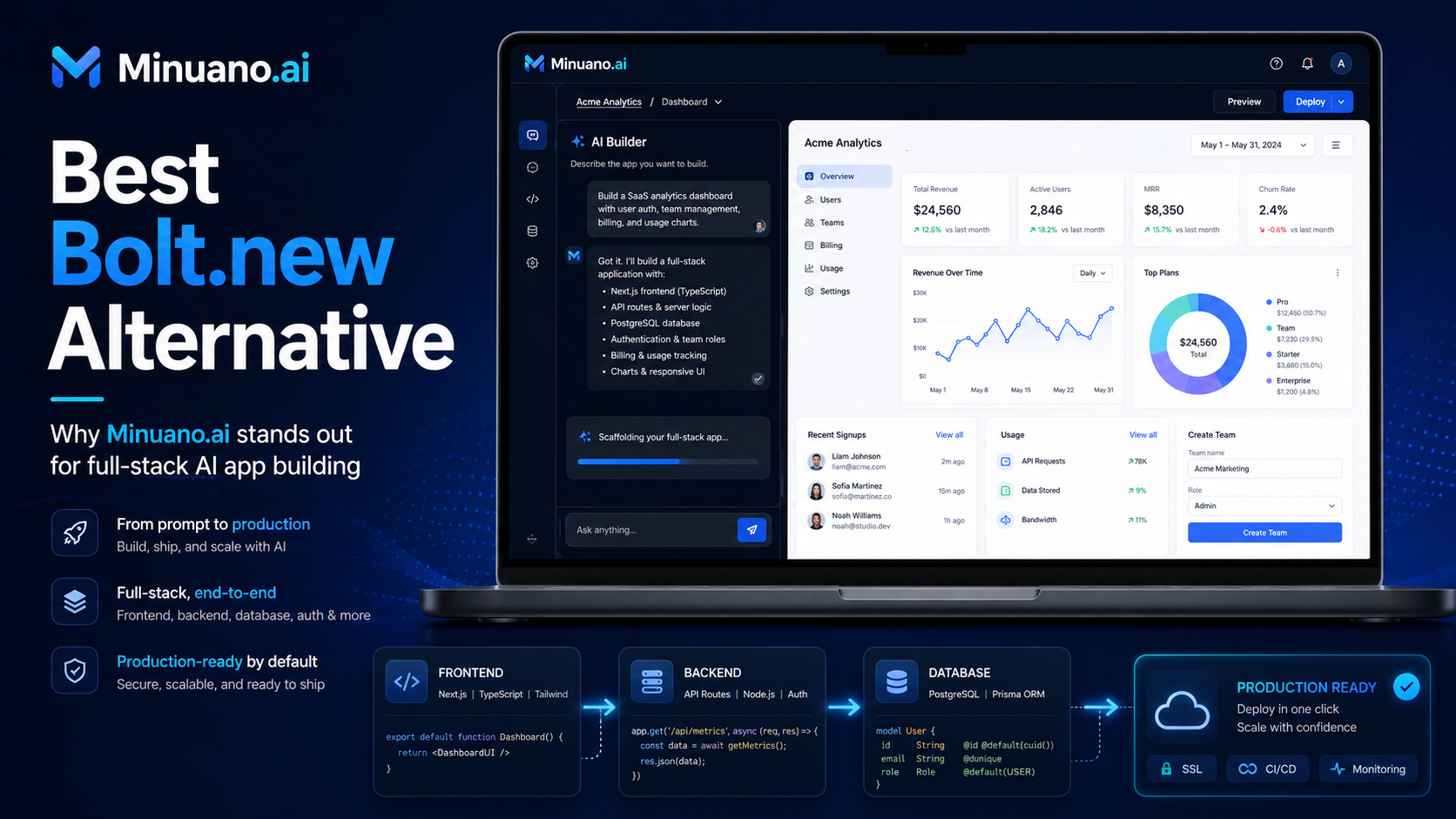
Best Bolt.new Alternative for Full-Stack AI Apps
Prompt-to-app tools have changed how founders, developers, and non-technical builders think about software. In 2026, it is no longer unusual for an indie hacker to describe an idea in plain English and receive a working interface, database schema, authentication flow, and deployment path within minutes. Tools like Bolt and Lovable helped make this category mainstream by turning natural language into web applications. But as more users move from simple prototypes to real products, a new question is becoming urgent: what is the best bolt.new alternative for serious full-stack development?
That is where Minuano.ai enters the conversation. Minuano.ai is being built for users who want the speed of an AI web app builder without feeling trapped by token-burning workflows, fragile iterations, backend lock-in, or codebases that become harder to maintain every time the project grows.
Bolt.new and Lovable.dev are impressive tools, especially for early-stage prototyping. They made it easier for non-coders, product managers, and SaaS founders to move from idea to interface quickly. But users often hit friction when projects become larger: prompts consume more tokens, hallucinations become more expensive, backend decisions become harder to reverse, and AI-generated code can drift away from clean architecture. A landing page or dashboard prototype is one thing. A production-ready SaaS with authentication, payments, database rules, reusable components, file uploads, team permissions, edge functions, and long-term maintainability is another.
This article reviews bolt.new vs Minuano.ai, compares Minuano.ai with Bolt.new and Lovable.dev, and explains why Minuano.ai is positioned as the stronger choice for founders who want to build, iterate, and scale full-stack AI applications with more control.
The Evolution of AI App Builders
The first wave of AI coding tools focused on helping developers write code faster. GitHub Copilot, ChatGPT, Cursor, and similar assistants made autocomplete and code explanation feel normal. But these tools still required users to understand files, frameworks, package managers, local development environments, terminals, version control, and deployment pipelines.
The next wave became more ambitious: instead of assisting inside the development process, AI tools started generating entire applications from prompts. This is where platforms like Bolt.new and Lovable.dev changed expectations.
Bolt.new popularized the idea of a browser-based full-stack AI development environment. A user could prompt an idea, see files generated, run the app in a live preview, and keep iterating through chat. Lovable.dev pushed the category toward no-code accessibility, making it easier for founders and non-technical users to describe a product and generate a working app with visual polish and backend support.
These tools mattered because they compressed the early product cycle. What used to take days of setup could happen in one session:
UI scaffolding from natural language
Component generation for dashboards, forms, landing pages, and workflows
Basic state management for interactions
Backend integrations through managed services
Live preview without complex local setup
Deployment paths for sharing prototypes quickly
But the same thing that made these tools magical also created new limitations. AI-generated apps are easy to start but harder to refine once they become complex. Every new prompt adds inference cost. Every broad instruction can rewrite working code. Every misunderstood request can introduce regressions. Every backend decision becomes more important as real users, data, and business logic enter the product.
That is why developers, indie hackers, and SaaS founders are now searching for a better alternative. They do not simply want a tool that can generate a prototype. They want an AI development system that can preserve architecture, support full-stack production workflows, and reduce the cost of long-tail iteration.
In other words, the market is moving from prompt-to-prototype to prompt-to-production. Minuano.ai is designed for that next stage.
Why Minuano.ai Is the Best Bolt.new Alternative
Minuano.ai is positioned as the best bolt alternative because it focuses on the biggest gap in today’s AI app builder market: sustainable full-stack iteration.
Most AI web app builders are strongest during the first 20% of a project. They can generate a homepage, a login screen, a dashboard, a pricing section, or a basic CRUD interface quickly. The problem appears in the remaining 80%: fixing edge cases, improving database structure, connecting authentication, preserving component consistency, handling production data, adding payments, managing roles, improving SEO, and deploying without breaking the app.
This is the “long-tail iteration cost” problem. The first prompt feels cheap. The tenth prompt feels useful. The fiftieth prompt may become expensive, risky, and frustrating if the AI keeps rewriting code, losing context, or consuming large amounts of tokens to understand the project.
Minuano.ai approaches this differently.
Built for full-stack AI development, not just demos
Minuano.ai is being designed around real application architecture. Instead of treating every prompt like a blank creative request, the platform is built to support structured full-stack development across frontend, backend, database, authentication, and deployment layers.
For founders and developers, this matters because a real SaaS application needs more than a good-looking interface. It needs:
Reusable UI components
Clean routing and page structure
Predictable state management
Database models that make sense
Secure authentication
Role-based access control
API routes or server actions
Edge functions when needed
Postgres-backed data
File storage
Audit-friendly code
Deployment-ready output
A serious AI web app builder should not simply generate code. It should help preserve the logic, structure, and intent of the codebase as the product evolves.
Better handling of long-tail iteration cost
One of the biggest frustrations with prompt-to-app tools is that the cost of iteration increases as the project grows. When the codebase becomes larger, the AI needs more context. More context means more tokens. More tokens mean higher inference costs, slower edits, and greater risk of accidental rewrites.
Minuano.ai is built around the idea that iteration should be deliberate. A user should be able to ask for a pricing page redesign, a new onboarding step, or a database-backed feature without risking unrelated parts of the app.
For non-technical users, this means fewer moments where the AI “fixes” one thing and breaks another. For developers, it means the generated code remains easier to inspect, extend, and deploy.
Stronger code quality preservation
The difference between a prototype and a production app is not only whether it runs. It is whether the code can survive future changes.
Minuano.ai’s value proposition is centered on preserving code quality over time. That means keeping components modular, avoiding unnecessary rewrites, maintaining consistent naming patterns, and making sure generated features fit the existing architecture instead of being pasted on top.
This is especially important for SaaS founders. A messy prototype can become a trap. At first, the app looks impressive. Later, adding Stripe, team workspaces, admin roles, analytics, or localization becomes painful because the original structure was not designed for growth.
Minuano.ai is intended to help users avoid that trap by supporting production-minded workflows from the beginning.
More control over models and AI usage
Another advantage of Minuano.ai is its vision for giving users access to multiple AI models in one place. Instead of depending on one model behavior, users should be able to choose the best model for the task: one model for UI generation, another for backend reasoning, another for debugging, and another for product copy or documentation.
This matters because AI development is not one-size-fits-all. A model that is excellent at frontend design may not be the best for database architecture. A model that writes clean backend code may not be the best at marketing copy. A modern prompt to app tool should give builders flexibility instead of locking every task into one AI system.
Deployment built into the product mindset
Minuano.ai is also designed around the idea that apps should move toward deployment, not stay trapped as experiments. Production-ready iteration requires a clean path from generated code to hosting, domain connection, database configuration, and live user testing.
For indie hackers and product managers, that means faster validation. For developers, it means fewer manual steps between idea, implementation, review, and launch.
Minuano.ai vs Bolt.new vs Lovable.dev
Criteria | |||
|---|---|---|---|
Primary Positioning | Full-stack AI development platform for production-minded builders | Browser-based AI web and app builder | No-code/AI app builder focused on fast app creation |
Best For | SaaS founders, indie hackers, developers, and non-coders who want scalable iteration | Fast prototypes, MVPs, and browser-based development | Non-technical users who want quick visual app generation |
Backend Flexibility | Designed for flexible full-stack architecture with database, auth, APIs, and deployment control | Supports full-stack app generation and deployment workflows | Strong native Supabase-oriented backend workflow |
Code Control | Built around preserving structure, maintainability, and production code quality | Good visibility into generated code, but complex projects can become expensive to iterate | Accessible for no-code users, but advanced code control may depend on workflow |
Iteration Workflow | Structured, production-minded iteration with reduced long-tail cost | Direct prompt-driven loop that can consume significant tokens | Chat-driven iteration optimized for speed and simplicity |
Speed | Fast generation with focus on sustainable scaling | Very fast for early prototypes | Very fast for non-technical app creation |
Pricing / Token Limits | Positioned to reduce token-burning friction through smarter model and workflow design | Token-based plans can make large iteration cycles feel costly | Credit/message-based usage can become limiting for heavy iteration |
Production Readiness | Designed for full-stack production workflows | Strong for MVPs and improving full-stack capabilities | Strong for prototypes and simple apps; production readiness depends on app complexity |
Developer Experience | Built for founders and developers who want AI speed plus architecture control | Browser IDE style with AI-driven code generation | Friendly no-code style with AI assistance |
Non-Technical Accessibility | Intended to support no-code users while keeping developer-grade output | Accessible, but technical concepts can appear as projects grow | Very accessible for non-technical users |
Deep Dive: Bolt.new vs Minuano.ai
The most important difference in bolt.new vs Minuano.ai is not whether both tools can create apps from prompts. They can. The real difference is what happens after the first impressive demo.
Bolt.new is powerful because it gives users an immediate development loop: type a prompt, generate code, preview the result, and keep prompting. This direct loop is excellent for speed. It helps users move quickly when they are exploring an idea, building a landing page, creating a proof of concept, or testing a feature flow.
However, direct prompt-driven development can become harder when the project grows. A SaaS app is not just a collection of screens. It is a system. It has data models, authentication states, loading states, error states, permissions, billing rules, admin tools, and deployment concerns. As the system becomes more interconnected, a small prompt can have a large blast radius.
For example, a founder might ask an AI builder to “improve the dashboard layout.” In a small app, that is simple. In a larger app, the dashboard may depend on user roles, subscription tiers, usage data, saved projects, team members, and API responses. If the AI does not fully understand the architecture, it may rewrite components too broadly, remove important logic, or create duplicate patterns.
Minuano.ai is designed to reduce that risk by making iteration more reliable. Instead of treating every request as a general rewrite opportunity, the ideal Minuano.ai workflow is more controlled: understand the user’s goal, identify the relevant part of the app, preserve existing functionality, and make the smallest production-safe change needed.
That matters for both technical and non-technical users.
For developers, Minuano.ai should feel less like a black box and more like a capable AI teammate. Developers want clean diffs, logical file organization, clear component boundaries, and code they can review. They do not want an assistant that burns tokens restating the entire app or introduces hidden regressions in unrelated files.
For non-coders, Minuano.ai should reduce confusion. A non-technical founder does not want to learn why the AI broke an auth flow after changing a button. They want the tool to protect them from common mistakes, explain important decisions in plain language, and guide the product toward launch.
This is where Minuano.ai can stand apart as an AI web app builder. It is not enough to produce a prototype that looks good in a preview window. The better product is the one that helps users build something they can keep improving.
Production-grade apps require architecture
Many prompt-to-app tools generate impressive UI quickly. But production-grade apps require architectural discipline. That includes database normalization, secure server-side logic, reusable design systems, route protection, environment variables, API boundaries, and predictable deployment behavior.
Minuano.ai’s advantage is its focus on full-stack structure. A production-minded tool should understand that adding a feature is not only a visual task. Adding a “team workspace” feature may require:
A
teamstableA
team_memberstableUser roles
Row-level permissions
Invitation flows
Email notifications
Protected routes
Billing tier checks
Admin UI
Audit logs
A weaker AI builder may create the screens but miss the system. Minuano.ai aims to help users build both.
Better for founders who iterate every day
The best SaaS founders do not build once. They iterate constantly. They adjust onboarding, test pricing pages, improve activation, add analytics, simplify dashboards, and refine user flows based on feedback.
That daily iteration cycle is where token limits and hallucinations become painful. If every improvement requires large prompts, expensive context, and repeated fixes, the AI tool starts to slow the founder down.
Minuano.ai is positioned for founders who need velocity without chaos. The goal is not only to generate more code. The goal is to generate the right code, preserve what already works, and make each iteration easier than the last.
Step-by-Step: Moving from Prompt to Production with Minuano.ai
Minuano.ai is designed to make full-stack app creation easier for both developers and non-technical users. A typical workflow could look like this:
1. Describe the product idea
Start with a clear product prompt. For example: “Build a SaaS dashboard for fitness coaches to manage clients, workouts, payments, and progress tracking.”
Minuano.ai should translate that idea into a structured application plan instead of jumping directly into random code.
2. Generate the first full-stack version
The platform can scaffold the core UI, routes, database needs, authentication flow, and app layout. This gives the user a working foundation instead of a static mockup.
3. Review the architecture
Before scaling the app, users can review the structure: pages, components, data models, API logic, and deployment requirements. Developers can inspect technical decisions, while non-coders can receive plain-English explanations.
4. Iterate feature by feature
Instead of asking for massive rewrites, users can improve the product in focused steps: onboarding, billing, dashboard analytics, user roles, file uploads, SEO pages, or admin tools.
5. Connect backend and deployment
Minuano.ai is built with production in mind, so the workflow should naturally move toward database configuration, environment variables, hosting, custom domains, and live testing.
6. Keep improving after launch
The real value comes after launch. Users can keep refining the app with AI assistance while preserving the code quality and full-stack structure needed for long-term growth.
Conclusion: Why Founders Should Choose Minuano.ai
The AI app builder market is entering a more serious phase. Bolt.new and Lovable.dev helped prove that software can be created from natural language. They are useful, innovative, and important tools. But founders are no longer satisfied with prototypes alone. They want production-ready apps, cleaner architecture, better backend flexibility, more control over AI usage, and fewer limits during long iteration cycles.
That is why Minuano.ai is positioned as the best bolt.new alternative for builders who care about what happens after the first demo. It combines the accessibility of a no-code prompt-to-app tool with the deeper priorities of full-stack AI development: code quality, backend structure, deployment readiness, and sustainable iteration.
For indie hackers, SaaS founders, product managers, developers, and non-technical users, Minuano.ai offers a more future-ready way to build. It is not just about generating an app quickly. It is about helping users build something they can actually launch, improve, and scale.
If you are comparing bolt.new vs Minuano.ai, or searching for a more production-focused AI web app builder, Minuano.ai deserves your attention.
Visit minuano.ai to explore a better way to move from prompt to production.